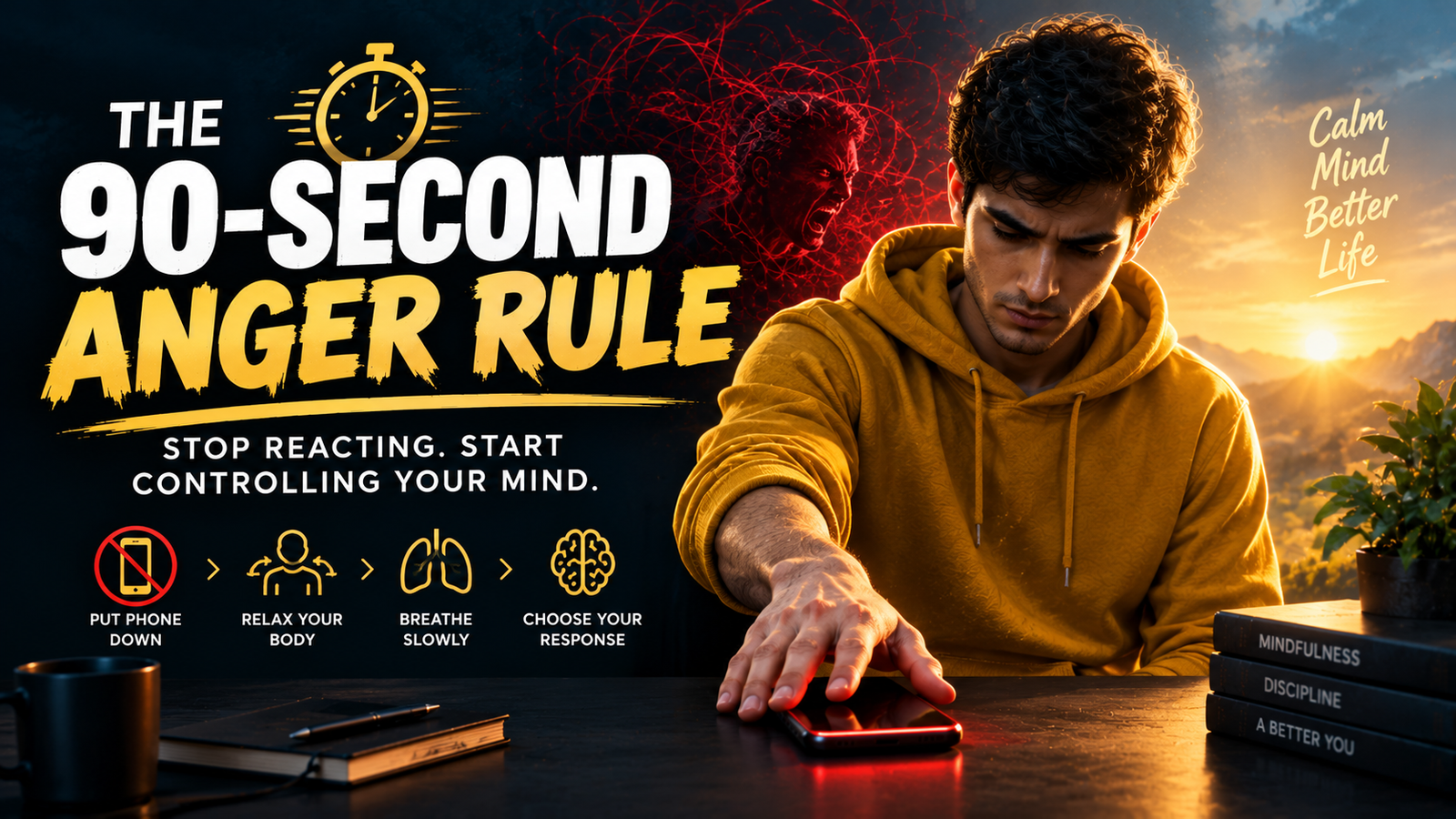
STOP REACTING. START CONTROLLING YOUR MIND.
Have you ever received a disrespectful message and spent the next three days thinking about it?
You replay the conversation in your head. You imagine what you should have said. You check the message again. Even when the other person has moved on, your mind keeps fighting the same battle.
Here’s an important question: Are you still reacting to what happened, or are you repeatedly bringing the experience back to life in your mind?
This is where the 90-second anger rule can offer a powerful practical lesson.
The idea is simple: when anger rises, give yourself a short pause before reacting. Instead of immediately replying, arguing, or making a decision, allow the first wave of emotion to settle.
It doesn’t mean every angry feeling disappears in exactly 90 seconds. Human stress responses are more complicated than that. But 90 seconds can be a useful starting point for interrupting an impulsive reaction.
Let’s understand how to use it.
1. Understand the First Wave of Anger
Anger is a natural human emotion. When something feels threatening, unfair, or disrespectful, your brain and body can prepare you to respond.
Your heart may beat faster. Your muscles may tighten. Your breathing may change. You might feel an immediate urge to defend yourself or confront someone.
These reactions are part of the body’s stress response.
The problem isn’t necessarily that you feel angry. The problem is what happens when you allow the first emotional impulse to control your next action.
You send the message you later regret. You say something hurtful. You turn a small disagreement into a major conflict.
The first step toward emotional control is recognizing that feeling anger doesn’t mean you must immediately act on it.
2. The 90-Second Pause: Don’t React Immediately
The 90-second rule is often associated with the idea that an initial emotional reaction can rise and begin to settle if we don’t continually reinforce it.
However, there is no universal biological timer that guarantees anger or stress hormones disappear after exactly 90 seconds. The duration of an emotional response varies depending on the person, situation, and intensity of the experience.
So think of 90 seconds as a practical pause—not a medical or neurological guarantee.
The next time you feel triggered, try this:
- Stop typing your response.
- Put your phone face down.
- Step away from the argument if possible.
- Take a slow breath.
- Give yourself time before deciding what to say.
You don’t have to win the moment. You need to avoid making it worse.
3. Stop Replaying the Argument
Imagine someone sends you a disrespectful message.
You read it once. Your body reacts. You feel angry.
A few minutes later, the physical intensity may have reduced, but your mind starts replaying the situation.
You read the message again. You imagine a stronger reply. You remember another argument from last month. You begin creating conversations that haven’t even happened.
This is the mental replay loop.
The original event may be over, but repeatedly thinking about it can keep the emotional experience active.
Ask yourself:
Am I solving the problem, or am I simply replaying it?
If there is something useful to do, identify the next step. If there is nothing you can change right now, give your attention permission to move elsewhere.
You cannot always control what happens, but you can practise choosing how you respond to it.
4. Use Your Body to Calm Your Mind
Anger isn’t just a thought. It can show up physically.
You might notice a clenched jaw, raised shoulders, tight fists, or shallow breathing.
Before trying to reason through the situation, relax your body.
Try this simple technique:
- Put your phone or device down.
- Unclench your jaw.
- Lower your shoulders.
- Relax your hands.
- Breathe in gently through your nose.
- Exhale slowly without forcing it.
- Repeat for a few comfortable breaths.
Slow breathing and relaxing tense muscles can help you create space between an emotional impulse and your response.
If the situation is becoming overwhelming, leave the conversation temporarily and return when you feel more settled.
5. Don’t Let One Moment Control Your Entire Day
Someone’s rude comment doesn’t have to become the story of your entire day.
A delayed reply doesn’t automatically mean disrespect. A disagreement doesn’t mean a relationship is over. A mistake doesn’t mean you are a failure.
Sometimes, the pain comes not only from what happened but also from the meaning we repeatedly attach to it.
Try separating the facts from your interpretation.
Fact: Someone didn’t reply to your message.
Interpretation: They don’t respect me.
Those are not necessarily the same thing.
Before reacting, ask whether you have all the information. This small habit can prevent unnecessary arguments and emotional exhaustion.
6. Choose Your Response Instead of Reacting
Emotional strength doesn’t mean never getting angry. It means learning not to let anger make every decision for you.
You can disagree without insulting someone. You can establish boundaries without losing control. You can walk away from an argument without feeling defeated.
When you feel angry, ask yourself three questions:
- Will my immediate reaction improve this situation?
- Is this worth sacrificing my peace over?
- What response will I respect tomorrow?
Sometimes the right response is a calm conversation. Sometimes it is a clear boundary. Sometimes it is silence and distance.
The goal isn’t to suppress your feelings. It is to respond thoughtfully rather than impulsively.
7. Stop Fighting Battles That Have Already Ended
One of the most exhausting habits is carrying yesterday’s arguments into today’s life.
You may be sitting with your family, working at your desk, or trying to sleep, but your mind is still somewhere else—replaying an old conversation.
Ask yourself:
Does this situation still require action, or am I keeping it alive through repetition?
If action is needed, decide what you can realistically do. If the situation is finished, practise redirecting your attention.
You deserve to spend your energy on the life you are building, not only on the conflicts you have already experienced.
The 90-Second Anger Practice
For the next seven days, try this whenever you notice anger rising:
First 30 seconds: Stop. Don’t send the message, make the call, or continue the argument.
Next 30 seconds: Relax your jaw and shoulders. Take slow, comfortable breaths.
Final 30 seconds: Ask yourself what actually happened, what you can control, and what response would be most useful.
If you still feel angry after 90 seconds, that’s okay. Take more time. Some situations require a longer break before you can respond calmly.
The objective is not to eliminate anger on a schedule. It is to stop giving an immediate emotional reaction control over your behaviour.
Final Thoughts: Don’t Give Yesterday’s Anger Another Day
You cannot control every person, message, disagreement, or disappointment that enters your life.
But you can practise controlling what you do next.
The next time someone disrespects you, pause before responding. Put your phone face down. Relax your shoulders. Take a breath. Give yourself enough time to choose your next action.
Remember, not every argument deserves your energy, and not every thought deserves another replay.
Stop fighting battles that ended yesterday. Protect your peace and take control of your response.
Stay calm. Stay focused. Stay happy.
Frequently Asked Questions
1. What is the 90-second anger rule?
It is a practical technique that encourages you to pause for about 90 seconds when anger rises before reacting. It creates time to settle and choose a thoughtful response.
2. Does anger really disappear after 90 seconds?
No. There is no scientific guarantee that anger or stress hormones disappear after exactly 90 seconds. Emotional responses vary. The 90-second period is best understood as a helpful pause rather than a biological deadline.
3. How can I control anger immediately?
Stop speaking or typing, relax your jaw and shoulders, take slow comfortable breaths, and step away if necessary. Avoid making important decisions while highly upset.
4. Why do I keep replaying arguments in my head?
You may be trying to understand what happened, find a better response, or resolve an uncomfortable feeling. But repeatedly replaying an event without reaching a solution can keep your attention stuck on it.
5. Is walking away from an argument a sign of weakness?
No. Taking a break can be a mature way to prevent escalation. You can return to the conversation when you are ready to communicate clearly and respectfully.