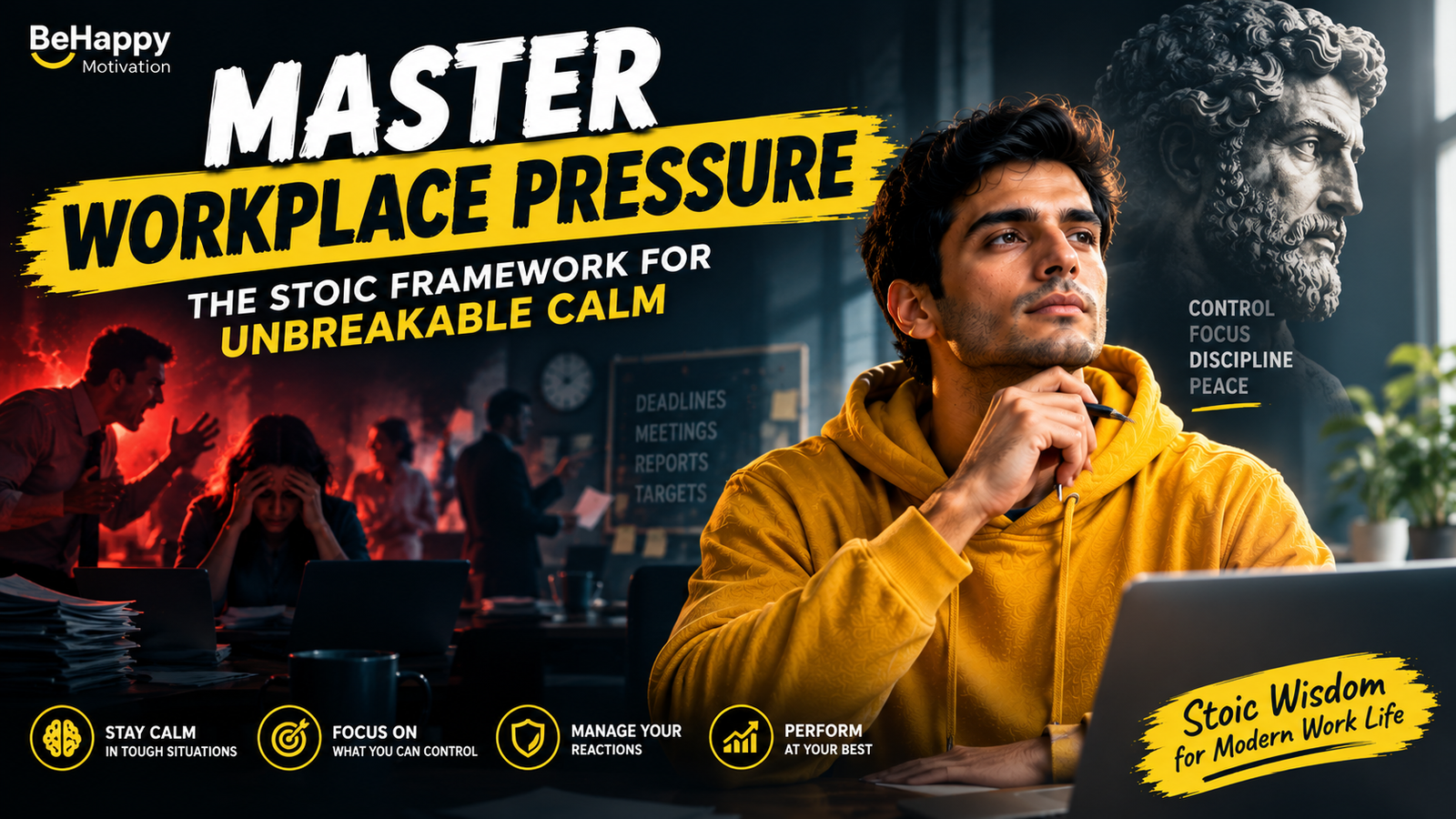
Workplace pressure is unavoidable. Deadlines become tighter, difficult colleagues test your patience, unexpected problems disrupt your plans, and sometimes your hard work goes unnoticed. In these moments, it is easy to let frustration, anxiety, or fear take control.
But what if you could face professional challenges without allowing them to disturb your inner peace?
The ancient philosophy of Stoicism offers a practical framework for doing exactly that. It teaches you to distinguish between what you can control and what you cannot, manage your emotional reactions, and focus your energy on meaningful action.
Stoicism does not mean becoming emotionless, accepting unfair treatment, or pretending that workplace problems do not exist. It means learning to respond thoughtfully instead of reacting impulsively.
Here is how to apply the Stoic framework to everyday workplace pressure.
1. Understand the Dichotomy of Control
One of the most important Stoic principles is the distinction between what is within your control and what is outside it.
You cannot completely control:
- Your manager’s opinions.
- Your colleagues’ behaviour.
- Unexpected changes in company decisions.
- Whether someone appreciates your work.
- Market conditions or organisational uncertainty.
However, you can influence:
- The quality of your work.
- Your preparation and discipline.
- How you communicate.
- Your response to criticism.
- The effort you put into solving problems.
Imagine that your manager criticises your presentation during a meeting. Your first reaction might be embarrassment or anger. You may spend the rest of the day replaying the conversation.
A Stoic approach asks a different question:
“What part of this situation can I actually improve?”
Perhaps the feedback contains something useful. Perhaps it was delivered poorly. You can evaluate both without allowing another person’s words to determine your entire emotional state.
Focus on your actions, not on controlling every outcome.
2. Separate Emotional Distress from Professional Performance
Feeling frustrated does not mean you have to perform poorly.
Stoicism encourages you to examine the judgments behind your emotional reactions. A difficult meeting is an event; the belief that it has ruined your career is an interpretation.
This distinction creates space between what happens and how you respond.
For example:
- Event: Your project deadline has been moved forward.
- Immediate interpretation: “Everything is going wrong.”
- More useful interpretation: “The timeline has changed. I need to reassess priorities.”
You do not need to deny your feelings. Acknowledge frustration, identify the actual problem, and decide what action is appropriate.
Your emotions can provide information, but they do not have to make your decisions.
3. Practise the Pause Before You React
A stressful email, an insulting comment, or an unexpected demand can trigger an immediate reaction.
You might respond defensively, send an angry message, or say something you later regret.
The Stoic solution is simple: create a pause.
Before responding to a difficult situation:
- Stop and take a comfortable breath.
- Identify what triggered your reaction.
- Ask whether your response will improve the situation.
- Choose your words carefully.
- Act when you can think clearly.
For example, if a colleague sends an aggressive email, you do not have to reply immediately. Step away, review the facts, and prepare a professional response.
Your first reaction may be automatic. Your next action can be deliberate.
4. Focus on Excellence, Not Recognition
One major source of workplace stress is the desire for constant appreciation.
You may work late, complete difficult projects, support colleagues, and still receive little recognition. If your motivation depends entirely on external approval, your professional confidence can become unstable.
Stoicism encourages you to focus on the quality of your actions rather than the applause they receive.
Ask yourself:
- Did I complete my responsibilities honestly?
- Did I give the task my best reasonable effort?
- Did I communicate clearly?
- Did I learn something from the experience?
- Did I act according to my values?
Recognition is welcome, but it should not be the only measure of your worth.
Do good work because it reflects your standards, not simply because someone might praise you.
5. Use Negative Visualisation to Prepare for Challenges
Stoic philosophers practised a technique often called premeditatio malorum, or the premeditation of difficulties.
The idea is to consider possible obstacles before they happen, so you can respond with greater preparation.
Before an important presentation, for example, consider:
- What if the presentation software fails?
- What if someone challenges my proposal?
- What if I cannot answer a question?
- What if the meeting runs behind schedule?
This is not about imagining disasters all day. It is about identifying realistic risks and preparing sensible responses.
Create a backup plan, organise your information, and practise your key points.
Preparation reduces unnecessary uncertainty and helps you approach difficult situations with greater confidence.
6. Practise the Stoic Evening Review
At the end of each working day, take five minutes to review your actions.
Ask yourself three questions:
What did I handle well today?
Recognise moments when you remained patient, communicated clearly, or solved a difficult problem.
Where did I react emotionally?
Identify situations where frustration, fear, or impatience influenced your behaviour. Do not use this exercise to criticise yourself.
What can I improve tomorrow?
Choose one practical adjustment. Perhaps you need better preparation, clearer communication, or stronger boundaries around your working hours.
This daily review turns workplace experiences into opportunities for learning.
7. Protect Your Boundaries and Know When to Act
Stoicism is sometimes misunderstood as silently tolerating everything.
That is not the purpose of the philosophy.
You can remain calm while addressing unreasonable workloads, disrespectful behaviour, unclear expectations, or unfair treatment.
For example, if you repeatedly receive tasks beyond your capacity, communicate your current workload and ask your manager to clarify priorities.
If someone behaves disrespectfully, set a professional boundary. If the behaviour continues, document relevant incidents and use appropriate workplace reporting channels.
Emotional control does not mean surrendering your rights. It means addressing problems with clarity rather than uncontrolled anger.
A Simple Stoic Routine for Your Working Day
You do not need to spend hours studying philosophy to apply Stoic principles. Begin with a simple daily routine:
- Morning: Identify your three most important priorities.
- Before stressful meetings: Prepare for possible challenges.
- During conflict: Pause before responding.
- When facing criticism: Separate useful feedback from personal interpretation.
- At the end of the day: Review your decisions and identify one improvement.
Consistency matters more than perfection.
Final Thoughts: Become the Calm Person in the Difficult Room
You cannot control every deadline, every colleague, every decision, or every unexpected workplace challenge.
But you can develop the ability to approach those situations with patience, discipline, and clear thinking.
That is the practical strength of Stoicism.
The next time workplace pressure builds, remember:
Control your actions. Question your assumptions. Prepare for challenges. Protect your peace.
Your professional success should not require you to sacrifice your mental well-being.
Be ambitious, work with discipline, and pursue excellence. But never forget that your peace of mind is also part of your success.
Watch More on BeHappy Motivation TV
Want to build a stronger mindset, improve emotional control, and develop habits that support personal growth?
Subscribe to BeHappy Motivation TV for motivational videos, practical psychology insights, Stoic philosophy, and self-improvement lessons.
👉 Subscribe to BeHappy Motivation TV on YouTube
Stay motivated. Keep learning. Keep growing.
Frequently Asked Questions
1. How does Stoicism help with workplace stress?
Stoicism encourages you to focus on your actions, manage your judgments, and avoid wasting energy trying to control things outside your influence. These principles can help you respond more thoughtfully to professional challenges.
2. Does being Stoic mean hiding your emotions at work?
No. Stoicism is not about suppressing emotions. It encourages understanding your emotional responses and choosing actions based on reason and values rather than immediate impulses.
3. How can I handle a difficult boss using Stoic philosophy?
Focus on clear communication, professional boundaries, and the quality of your work. Separate useful feedback from unhelpful criticism, and address inappropriate behaviour through suitable workplace channels.
4. What is the most important Stoic principle for workplace pressure?
The dichotomy of control is a useful starting point: recognise what you can influence and direct your effort towards those things instead of becoming consumed by external outcomes.
5. Can Stoicism improve professional performance?
Stoic practices may support better decision-making, emotional regulation, preparation, and consistency. They are useful skills, although they do not remove every source of workplace stress.