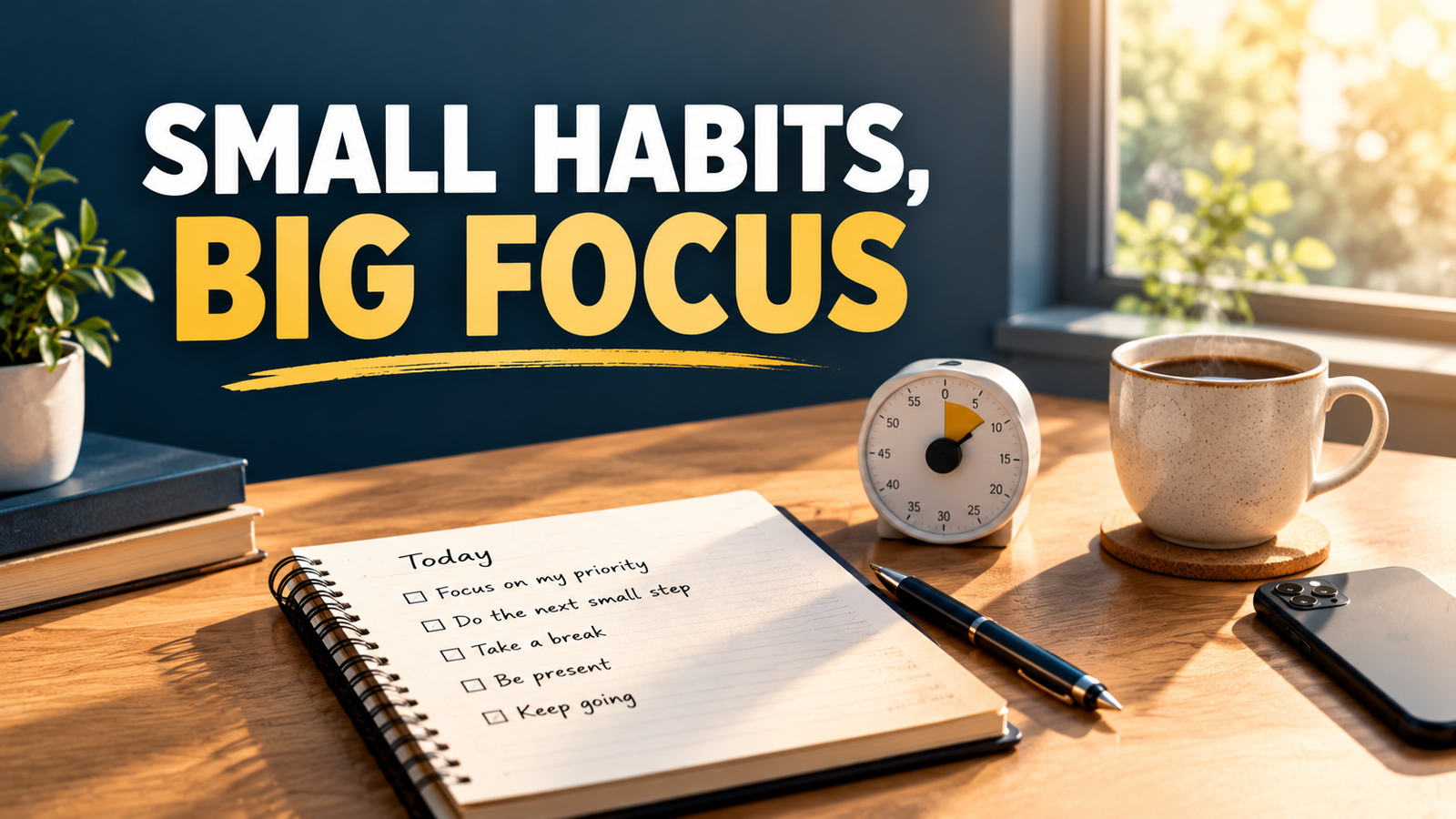
Have you ever ended a busy day feeling like you did a hundred things but somehow made no real progress?
You answered messages, checked your phone, attended meetings, handled unexpected tasks, and promised yourself you would finally work on something important tomorrow. Then tomorrow arrived, and the same thing happened again.
It is frustrating, especially when you know you are capable of doing more.
The problem is not always a lack of motivation. Sometimes, your day simply has no system to protect your attention.
This is where daily micro-habits and focus systems can help. Instead of trying to transform your entire life overnight, you make small changes that are easy to repeat. Over time, those changes can make it easier to get started, stay focused, and finish the work that matters.
You do not need a perfect morning routine or an expensive productivity app. You need a few simple habits that fit your real life.
What Are Daily Micro-Habits?
Micro-habits are small actions that require very little effort to begin. They might take less than a minute or involve making an existing activity slightly more intentional.
For example, you could write down your top priority before opening your email, read one page of a book before bed, or put your phone out of reach while working.
These actions may seem insignificant on their own. But their real value comes from repetition.
A small habit is also easier to maintain on a difficult day. You might not have the energy for an hour-long workout, but you can probably stretch for two minutes. You may not feel ready to write a complete article, but you can open the document and write the first sentence.
The goal is not to do the bare minimum forever. It is to make starting easier, so you can build momentum when you have the time and energy.
1. Start Your Day by Choosing Three Priorities
One of the easiest ways to lose focus is to begin the day reacting to everyone else’s demands.
You open your inbox, reply to messages, check notifications, and suddenly find yourself busy without knowing what you have actually accomplished.
Try a different approach.
Before opening your email or social media, spend two minutes identifying three priorities for the day. These should be tasks that would make the day feel productive if you completed them.
Keep the list realistic. If you have a full schedule, do not write down ten major goals and then feel disappointed when you finish only four.
Ask yourself: What are the three things that deserve my attention today?
You can still handle urgent requests and unexpected responsibilities. The list simply gives you a direction to return to when the day gets chaotic.
2. Make Your Habits So Small That You Cannot Easily Avoid Them
A common mistake is starting with too much enthusiasm.
You decide to wake up at 5 a.m., exercise for an hour, meditate, read twenty pages, and spend two hours learning a new skill. It feels exciting for a few days, but eventually your schedule becomes difficult to maintain.
Instead, make the first version of your habit almost ridiculously simple.
- Want to read more? Start with one page.
- Want to exercise? Begin with five minutes of movement.
- Want to write regularly? Write one paragraph.
- Want to meditate? Sit quietly and focus on your breathing for one minute.
- Want to learn a skill? Spend five minutes practising.
Once the habit feels familiar, you can increase the time or effort.
Remember, a small beginning is not a small ambition. It is a practical way to make consistency easier.
3. Use Focus Blocks Instead of Working All Day Without a Plan
Have you noticed how exhausting a day can feel when you keep switching between tasks?
You write a few lines, check a notification, answer a message, return to your work, and then remember something else you need to do.
Every switch makes it harder to keep your attention on one thing.
A simple solution is to work in focused blocks.
Choose one task, set a timer for 25 minutes, and give that task your attention until the timer ends. Take a short break, then repeat if needed.
If 25 minutes feels too long, begin with ten. If you are working on something complex, you may eventually prefer longer blocks.
The exact duration matters less than the principle: decide what you are doing before you begin, and reduce interruptions while you do it.
During each block, keep unrelated tasks on a piece of paper rather than immediately acting on every thought that comes to mind.
This helps you stay with the work instead of constantly starting over.
4. Remove Distractions Before You Need Willpower
It is tempting to believe that productive people simply have stronger self-control. But they often make their environment easier to work in.
If your phone is beside your keyboard, notifications are appearing on your screen, and several browser tabs are competing for your attention, you are creating unnecessary distractions.
Try making focus the easiest option.
Put your phone in another room or switch on Do Not Disturb. Close tabs you do not need. Keep only the materials related to your current task on your desk.
You can also set specific times to check messages rather than responding to every notification immediately.
These changes do not require extraordinary discipline. They reduce the number of times you have to use it.
A useful focus system does not depend on resisting every distraction. It makes distractions less available in the first place.
5. Connect New Habits to Things You Already Do
Remembering to start a new habit can be harder than performing the habit itself.
One simple technique is to attach it to something you already do every day.
For example:
- After making your morning tea, write down your main priority.
- After lunch, take a five-minute walk.
- After sitting at your desk, put your phone away.
- After brushing your teeth at night, read one page.
- After finishing work, write down tomorrow’s first task.
This approach gives your new habit a natural starting point.
You do not need to rely entirely on memory or wait until you feel motivated. The existing routine becomes a reminder.
Start with one connection and practise it until it feels familiar. Adding five new habits at once can make the whole system harder to maintain.
6. Create a Simple Rule for Procrastination
Sometimes, you know exactly what needs to be done, but you still avoid starting.
The task may feel too large, boring, confusing, or uncomfortable. You tell yourself you will begin after checking one more thing, and suddenly half an hour has disappeared.
When this happens, stop trying to convince yourself to finish the entire task.
Instead, commit to working on it for just five minutes.
Open the document. Write the first few lines. Review the first page. Make the first phone call.
You are not promising to complete everything. You are only making a small agreement to begin.
Once you get started, the task may feel less intimidating. Even if you stop after five minutes, you have made progress and reduced the barrier to returning later.
If procrastination keeps happening, also look at the reason behind it. A task may need to be broken into smaller steps, clarified, scheduled, or discussed with someone who can help.
7. Protect Your Energy, Not Just Your Time
Productivity is not only about how many hours you work. It is also about the energy and attention you bring to those hours.
If you are tired, hungry, overwhelmed, or constantly interrupted, even a simple task can feel difficult.
Pay attention to the basics. Maintain a reasonably consistent sleep schedule, take breaks, drink water, move your body regularly, and allow yourself time away from screens.
Notice when you tend to feel most alert. If possible, use that period for work that requires concentration. Save routine administrative tasks for times when your energy is lower.
You do not need to optimise every minute of the day. You simply need to recognise that your attention is a limited resource.
Rest is not the opposite of productivity. It helps make sustainable effort possible.
8. Use an Evening Reset to Make Tomorrow Easier
The way you finish your day can influence how easily you begin the next one.
If you stop working without reviewing what happened, unfinished tasks may keep circling through your mind. You might go to bed worrying about everything you need to remember tomorrow.
Spend five minutes on an evening reset.
First, write down what you completed. This helps you recognise progress, even if the day did not go exactly as planned.
Next, list any unfinished tasks that still need attention. Decide which ones matter most and identify the first step for tomorrow.
Finally, clear your desk or prepare whatever you need to begin.
For example, if you want to write in the morning, leave your document open with a note describing the next paragraph.
The purpose is not to create another complicated routine. It is to reduce the number of decisions you have to make when you start again.
9. Track Consistency Without Becoming Obsessed With Streaks
Habit trackers can help you see whether you are following through on your intentions. A calendar, notebook, or simple checklist is enough.
Choose one or two habits and mark each day you complete them.
For example, you might track whether you wrote down your priorities or completed one focused work block.
But remember that missing a day does not erase your progress.
Life happens. You get sick, plans change, family responsibilities come up, or work becomes unexpectedly busy.
Instead of abandoning a habit because you broke a streak, return to it at the next reasonable opportunity.
The purpose of tracking is to notice patterns, not to make yourself feel guilty.
If a habit repeatedly fails, ask whether it is too ambitious, poorly timed, or difficult to remember. Adjust the system rather than simply blaming yourself.
10. Build a Focus System You Can Use on Difficult Days
The best productivity routine is not necessarily the one that looks impressive online. It is the one you can return to when your schedule is messy and your motivation is low.
Create a basic version of your day with just three steps:
Choose: Identify the one task that matters most.
Focus: Work on it for a manageable block of time without unnecessary interruptions.
Reset: Record the next step so it is easier to continue later.
On a good day, you can repeat the process several times. On a difficult day, completing one focused block may be enough.
This approach gives you a flexible structure without requiring every day to be perfect.
A Simple Daily Micro-Habit Routine
If you are not sure where to begin, try this routine for one week.
Morning — 2 minutes: Write down your three priorities.
Before work — 1 minute: Silence notifications and prepare your workspace.
During the day — 25 minutes: Complete one focused work block, or start with ten minutes if needed.
Afternoon — 5 minutes: Take a short walk or step away from your screen.
Evening — 5 minutes: Review your progress and write down tomorrow’s first task.
You can adjust the timing to fit your life. The goal is to create a routine that supports your responsibilities rather than becoming another responsibility itself.
Start with the morning priority list and one focused work block. Add the remaining habits only when the first two feel manageable.
Final Thoughts: Small Habits Can Change the Way You Work
You do not need to become a completely different person to improve your focus.
You do not need to wake up at dawn, follow a complicated routine, or spend money on the latest productivity tools.
You can begin by choosing your priorities, making distractions less accessible, starting tasks in smaller steps, and giving your attention to one thing at a time.
Some days will be productive. Others will be difficult. What matters is having a simple system that helps you begin again.
Micro-habits are not magic, and they will not solve every problem. But when they fit your life and are repeated consistently, they can make useful actions easier to perform.
Start with one small habit today. Practise it tomorrow. Adjust it when necessary.
You do not have to change your entire life in one day. You just have to make the next useful action a little easier.
Your progress is built in ordinary moments, one small decision at a time.
Frequently Asked Questions
What are the best daily micro-habits for productivity?
Start with writing down your top priority, putting your phone away during focused work, taking short movement breaks, and planning your next task before finishing the day. Choose habits that solve a real problem in your routine.
How long does it take to build a new habit?
There is no fixed timeline. It depends on the habit, the person, and the circumstances. Focus on repeating the behaviour and making it easier to perform instead of expecting it to become automatic by a particular date.
What is a focus system?
A focus system is a simple set of rules and routines that helps you direct your attention. It might include choosing a priority, using timed work blocks, reducing notifications, and reviewing progress at the end of the day.
Can micro-habits help with procrastination?
They can make starting less intimidating. Breaking a large task into a small first step, such as working for five minutes, can reduce the initial resistance. Persistent procrastination may also require addressing stress, unclear expectations, or other underlying difficulties.
How many habits should I start with?
Begin with one or two. Once they fit comfortably into your routine, consider adding another. A smaller system you actually use is more helpful than a long list of habits you struggle to maintain.
This article is for general educational purposes. Productivity strategies should be adapted to your needs, health, responsibilities, and working conditions.