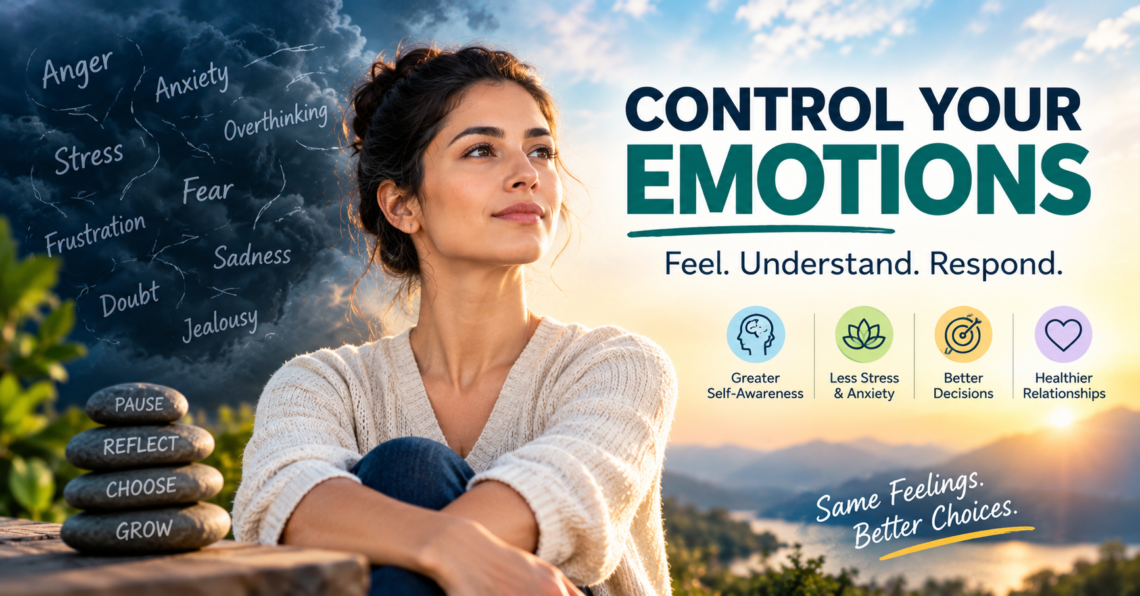
Introduction: Master Your Emotions Before They Master You
Have you ever said something in anger and regretted it a few minutes later? Have you ever allowed fear to stop you from taking an important step or spent hours thinking about something that happened days ago?
These experiences are common. We all experience anger, sadness, fear, frustration, jealousy, and disappointment. The real challenge is not experiencing these emotions. It is deciding what to do when they appear.
Imagine receiving a message that makes you angry. You can immediately send a harsh reply, or you can pause, understand what upset you, and respond when your mind is clearer. The situation may be the same, but your response can change the outcome.
Emotional strength is not about feeling nothing. It is about feeling deeply without reacting impulsively.
Emotional regulation is a skill that can improve with awareness, practice, and the right strategies. The American Psychiatric Association explains that recognizing emotions and choosing how to respond can help people handle difficult situations more effectively. <a href=”https://www.psychiatry.org/News-room/APA-Blogs/Understanding-Emotional-Regulation”>Read its guide to emotional regulation</a>.
1. Pause Before You React
When emotions become intense, your first impulse may not be your wisest response.
Before replying to a difficult message, entering an argument, or making an important decision, give yourself a moment.
Try this simple method:
- Stop talking or typing.
- Take a few slow, comfortable breaths.
- Relax your shoulders and jaw.
- Give yourself time to think before responding.
Even a short pause can create space between what you feel and what you do.
Remember: you do not have to respond to every situation immediately.
2. Identify What You Are Feeling
Sometimes, anger is not the real problem. It may be covering disappointment, embarrassment, fear, or the feeling of being ignored.
Instead of saying, “I am in a bad mood,” try to be more specific.
Ask yourself:
- Am I angry, hurt, anxious, or disappointed?
- What exactly triggered this feeling?
- What do I need right now?
- Is there something practical I can do about it?
Naming an emotion can help you understand your experience rather than becoming completely absorbed in it.
You can acknowledge a feeling without allowing it to dictate your behavior.
3. Challenge the Thoughts Behind Your Emotions
Our emotions are influenced not only by what happens but also by how we interpret what happens.
Suppose a colleague does not respond to your message. You might think, “They do not respect me.” That thought could create anger even though you do not yet know the reason for the silence.
Before accepting your first interpretation as fact, consider other explanations.
Ask yourself:
- What evidence supports my assumption?
- Could there be another explanation?
- Am I reacting to what happened or what I fear it means?
This does not mean ignoring genuine problems. It means separating facts from assumptions so you can respond more accurately.
4. Learn to Manage Anger Without Suppressing It
Anger can signal that something feels unfair, frustrating, or threatening. However, expressing anger through insults, threats, or aggressive behavior can create problems that last much longer than the original disagreement.
When you notice anger building:
- Recognize your early warning signs, such as a faster heartbeat or tense muscles.
- Step away from the conversation if it is safe to do so.
- Allow yourself time to settle before discussing the issue.
- Explain what bothered you using clear, respectful language.
- Focus on resolving the problem rather than winning the argument.
For example, instead of saying, “You never listen to me,” try, “I felt ignored when I could not finish explaining my point.”
You can be firm about your boundaries without being disrespectful.
5. Stop Living Inside Every Thought
Overthinking can keep painful emotions alive long after an event has ended.
You may replay an argument, imagine future failures, or repeatedly ask yourself why someone behaved a certain way. Thinking carefully can be useful, but repeating the same thoughts without reaching a decision often increases distress.
Try bringing your attention back to the present.
Take a short walk, notice your surroundings, write down your concerns, or focus on a task you can complete today.
When a worry returns, ask: “Is there an action I can take right now?”
If the answer is yes, choose one manageable step. If the answer is no, practise allowing the uncertainty to exist without repeatedly trying to solve it.
Mindfulness can help you observe thoughts and feelings without automatically reacting to them. <a href=”https://www.nhs.uk/mental-health/self-help/tips-and-support/mindfulness/”>Explore the NHS mindfulness guide</a>.
6. Build Habits That Support Emotional Balance
Your emotional well-being is affected by your daily routine. Poor sleep, prolonged stress, inactivity, and insufficient support can make difficult situations harder to manage.
You cannot eliminate every source of stress, but you can strengthen the habits that help you cope.
Try to:
- Maintain a regular sleep schedule.
- Make time for physical activity.
- Take short breaks during stressful work.
- Spend time with supportive people.
- Practise a few minutes of mindful breathing.
- Write down recurring concerns and possible solutions.
These habits are not instant solutions. They are practical ways to support your ability to handle everyday challenges.
7. Accept What You Cannot Control
Many emotional struggles come from trying to control things that are outside our influence.
You cannot control another person’s opinions, every unexpected event, or every outcome. You can, however, work on your own choices, boundaries, preparation, and responses.
When a situation feels overwhelming, divide it into two categories:
What I can control: My actions, my words, my effort, my decisions, and how I communicate.
What I cannot fully control: Other people’s reactions, the past, unexpected changes, and every possible outcome.
Put your energy into the first category.
Acceptance does not mean approving of unfair treatment or giving up on your goals. It means recognizing reality clearly enough to decide what to do next.
8. Practise Emotional Control Every Day
Emotional regulation develops through practice, not through one inspiring moment.
At the end of each day, spend two minutes reflecting on a situation that affected you emotionally.
Ask yourself:
- What happened?
- What did I feel?
- How did I respond?
- What could I try differently next time?
Do not use this exercise to criticize yourself. Use it to identify patterns and learn from experience.
You will not respond perfectly every time, and that is normal. What matters is gradually becoming more aware of your triggers and more intentional about your actions.
Conclusion: Feel Your Emotions, but Choose Your Actions
Life will continue to bring difficult conversations, disappointments, unexpected changes, and moments of uncertainty. You cannot prevent every emotional reaction, but you can learn to respond with greater awareness.
Pause before reacting. Identify what you feel. Question assumptions. Communicate clearly. Take care of your well-being, and ask for help when you need it.
The goal is not to become a person who never gets angry, sad, anxious, or disappointed. The goal is to become someone who can experience those feelings without allowing them to make every decision.
You may not control every emotion that enters your mind, but with practice, you can learn to choose what you do next.
That is where emotional strength begins.
Frequently Asked Questions
1. How can I control my emotions immediately?
Pause, take a few slow and comfortable breaths, name the emotion, and delay any impulsive response if possible. If the situation is escalating, step away safely and return when you feel calmer.
2. How can I stop getting angry over small things?
Notice your common triggers, look for underlying stress or unmet needs, and practise pausing before responding. If anger is frequent or difficult to manage, professional support can help you identify patterns and develop better coping skills.
3. Is controlling emotions the same as suppressing them?
No. Emotional regulation means recognizing feelings and choosing how to respond. Suppression means trying to hide or push away feelings without necessarily understanding them.
4. How can I stop overthinking emotional situations?
Write down the facts, separate them from assumptions, and identify one useful action. If no action is possible right now, redirect your attention to the present instead of repeatedly replaying the situation.
5. Can emotional intelligence be developed?
Yes. Skills such as recognizing emotions, understanding triggers, considering different perspectives, and communicating calmly can improve through regular practice.
how to control your emotions, emotional intelligence, emotional regulation, anger management, self-control, how to stay calm, manage stress, stop overthinking, mental strength, personal growth, self improvement, mindfulness, emotional balance