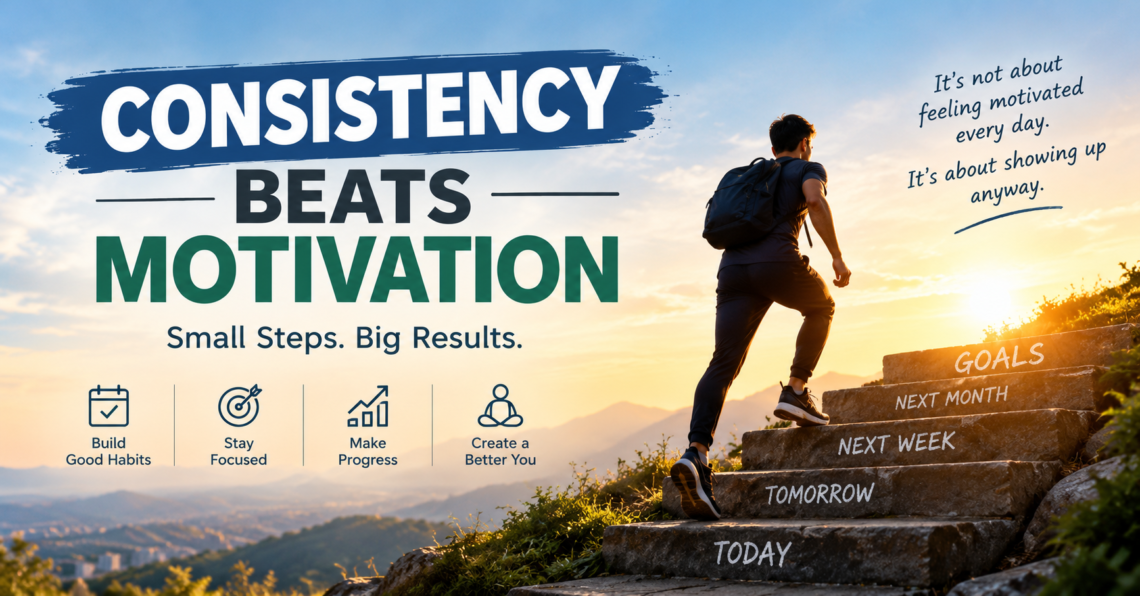
Stop Waiting to Feel Motivated
Have you ever started something with incredible enthusiasm, only to give up a few days later?
Perhaps you planned to exercise regularly, learn a new skill, start a business, write a book, or improve your life. In the beginning, everything felt possible. You made ambitious plans and promised yourself that this time would be different.
Then life happened. You became tired, work became stressful, and your excitement slowly disappeared.
This is where many people lose their progress. They believe they need motivation to continue, when what they really need is consistency.
Motivation helps you start, but consistency helps you keep going.
You do not have to feel inspired every day to make progress. You simply need to take small, meaningful actions regularly, even when the excitement of starting something new has faded.
Why Consistency Beats Motivation
Motivation is a feeling. It can be powerful, but it naturally changes with your mood, energy, circumstances, and environment. Some days you feel ready to conquer the world. On other days, even a simple task feels difficult.
Consistency works differently. It creates a pattern of action that does not depend entirely on how you feel.
Imagine two people who want to improve their fitness. The first person exercises intensely for one week whenever motivation is high, then stops for a month. The second person begins with a manageable routine and follows it regularly.
Over time, the second person has more opportunities to develop strength, improve technique, and build a sustainable habit.
The same principle applies to learning, business, relationships, and personal development. Regular effort creates opportunities for improvement that occasional bursts of enthusiasm cannot reliably provide.
Research on habit formation also supports the value of small, repeatable actions and stable routines. James Clear’s practical guide to building habits explains why starting small can make new behaviors easier to maintain.
1. Small Actions Create Big Changes
One of the biggest mistakes people make is trying to change everything at once.
They decide to wake up extremely early, exercise for an hour, read dozens of pages, learn a new skill, and complete every task perfectly. The plan may look impressive, but it can quickly become overwhelming.
Instead, make the first step small enough to repeat.
- Want to read more? Start with five pages a day.
- Want to learn a skill? Practice for 15 minutes.
- Want to start a business? Complete one important task daily.
- Want to improve your writing? Write one paragraph.
- Want to become more organized? Spend five minutes planning tomorrow.
These actions may seem insignificant, but they lower the barrier to getting started.
The objective is not to achieve extraordinary results on the first day. It is to build a routine you can realistically maintain and gradually improve.
2. Discipline Keeps You Moving When Motivation Fades
Discipline is not about being perfect or forcing yourself to work without rest. It is about honoring reasonable commitments, even when you do not feel particularly enthusiastic.
Suppose you have decided to spend 30 minutes learning a new skill every evening. One day, you feel tired and distracted.
Instead of abandoning the habit completely, you might practice for five minutes. On another day, you may have enough energy to complete the full session.
This flexible approach helps you maintain the connection between your intention and your actions.
Remember that rest is also important. Consistency does not mean ignoring illness, exhaustion, or your personal responsibilities. It means returning to your routine when you are ready rather than allowing one difficult day to become a permanent stop.
3. Stop Depending on Willpower Alone
If you have to make the same difficult decision every day, eventually you may find it harder to follow through.
A better approach is to design your environment so that the desired action becomes easier.
For example:
- Keep your book beside your bed if you want to read at night.
- Schedule learning time on your calendar.
- Prepare your workout clothes in advance.
- Turn off unnecessary notifications during focused work.
- Break a large project into smaller, clearly defined tasks.
These simple changes reduce the effort required to begin.
According to James Clear’s discussion of motivation, taking action can itself help generate momentum. Rather than waiting for the perfect feeling, make the first step easier and allow progress to follow. Explore motivation and habit strategies.
4. Focus on Progress, Not Perfection
Perfectionism often disguises itself as ambition. You may delay starting because you want the perfect plan, the perfect tools, or the perfect moment.
But progress rarely happens under perfect conditions.
Your first attempt may be average. Your early results may be disappointing. You may make mistakes that reveal how much you still need to learn.
That is not failure. It is part of the process.
Instead of asking, “Did I do everything perfectly today?” ask yourself, “Did I take a useful step forward?”
Track the actions you control, not only the results you hope to achieve. You cannot guarantee immediate success, but you can improve your preparation, effort, and willingness to learn.
Consistency does not guarantee success, but it gives your efforts more opportunities to produce results.
5. What to Do When You Break Your Routine
Even disciplined people miss days. Unexpected responsibilities, travel, illness, and stressful periods can interrupt the best plans.
The important thing is how you respond.
Do not turn one missed day into a reason to abandon your goal. Avoid judging yourself harshly or trying to compensate with an unrealistic amount of work.
Instead, identify what interrupted your routine and make the next step manageable.
If your daily reading stopped because your evenings became busy, move it to the morning. If your project feels overwhelming, reduce the next task. If your schedule is unrealistic, adjust it.
A setback can provide useful information about what needs to change.
The goal is not an unbroken record of perfect performance. The goal is to build a sustainable pattern of returning to the work that matters.
A Simple 7-Day Consistency Challenge
You do not need to transform your entire life this week. Choose one meaningful habit and practice it for the next seven days.
Day 1: Choose one clear, achievable goal.
Day 2: Set a specific time and place for the activity.
Day 3: Make the first step easier and remove one distraction.
Day 4: Complete the habit, even if you can only do a small version.
Day 5: Notice what makes the routine easier or harder.
Day 6: Adjust your plan to fit your real schedule.
Day 7: Review your progress and decide how you will continue next week.
At the end of the challenge, focus on what you learned rather than judging yourself solely by the outcome. Seven days will not solve every problem, but they can help you begin building a repeatable routine.
Conclusion: Become the Person Who Keeps Showing Up
Your future is influenced by the actions you repeat, the skills you practice, and the choices you make over time.
You do not need to feel motivated every morning. You do not need to make enormous progress every day. And you certainly do not need to compare your beginning with someone else’s finished achievement.
You need a meaningful direction, a realistic plan, and the willingness to continue when progress feels slow.
Start small. Stay patient. Learn from setbacks. Celebrate genuine progress, and allow your habits to grow with you.
The next time you find yourself waiting for motivation, remember this:
You do not have to feel ready to take the first step. Sometimes, taking the first step is what helps you become ready.
Your goals deserve more than occasional enthusiasm. Give them consistent effort, one day at a time.
Frequently Asked Questions
1. Why is consistency more important than motivation?
Motivation fluctuates, while a consistent routine makes it easier to continue working toward a goal even when enthusiasm decreases. Both can be useful, but consistency helps turn intentions into repeated actions.
2. How can I become more consistent every day?
Start with one small habit, choose a regular time for it, reduce distractions, and track your progress. Make the habit manageable enough to repeat during an ordinary, busy day.
3. How long does it take to build consistency?
There is no universal timeline. It depends on the behavior, your circumstances, and how frequently you practice it. Focus on repetition and gradual improvement instead of expecting a habit to become automatic by a specific date.
4. What should I do when I lose motivation?
Reduce the task to a manageable first step, remind yourself why it matters, and follow your planned routine when appropriate. If you are genuinely exhausted or unwell, rest and return when you can.
5. What is the difference between discipline and consistency?
Discipline is the ability to follow through on a commitment despite resistance. Consistency is the repeated practice of an action over time. They work together to support lasting progress.
consistency beats motivation, consistency is the key to success, self discipline, daily habits, personal growth, motivational article, success mindset, positive habits, how to stay consistent, discipline and motivation, self improvement, productivity tips, building good habits