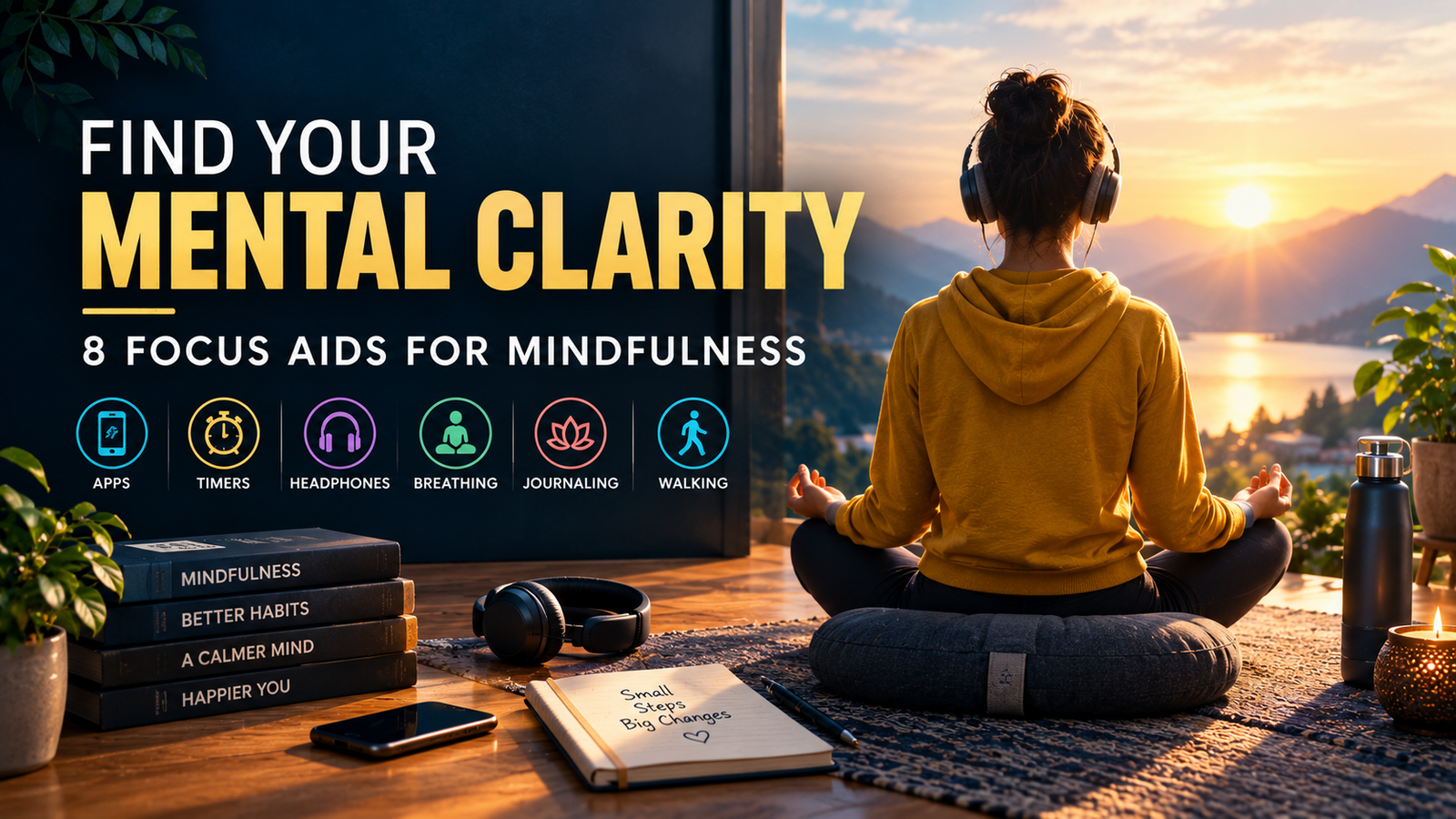
Have you ever sat down to meditate, closed your eyes, taken a deep breath, and suddenly remembered ten things you forgot to do?
Your mind jumps from unfinished work to tomorrow’s plans. You hear every little noise around you. Even after several minutes, concentrating on your breathing feels like a challenge.
If this sounds familiar, you’re not alone.
Mindfulness is often described as the practice of being present, but developing that ability takes patience. Fortunately, you don’t have to rely on willpower alone. A few simple focus aids can make meditation more comfortable, reduce distractions, and help you build a consistent mindfulness routine.
The best part? You don’t need expensive equipment or complicated technology to begin.
Here are some commonly recommended focus aids that can support mental clarity during mindfulness practices.
1. Guided Meditation Apps: Let Someone Guide Your Attention
For beginners, guided meditation is one of the easiest ways to get started.
Instead of wondering what to do with your thoughts, you listen to a calm voice that guides you through breathing, body awareness, relaxation, or focused attention.
Popular options include:
- Headspace: Beginner-friendly guided sessions and structured mindfulness programs.
- Calm: Guided meditation, breathing exercises, and relaxation content.
- Insight Timer: A large library of guided meditations, mindfulness sessions, and ambient sounds.
These apps can help create structure, especially when you find silent meditation difficult.
A 2025 randomized controlled trial examining an app-based mindfulness program found reductions in perceived stress among novice meditators. However, results can vary between individuals and programs. https://academic.oup.com/abm/article/59/1/kaaf025/8116836
Try this: Begin with a guided meditation lasting five to ten minutes. Choose one focused on breathing or present-moment awareness.
2. Meditation Timers: Focus Without Checking the Clock
One surprisingly useful focus aid is a simple meditation timer.
When you repeatedly open your eyes to check how much time remains, you interrupt your practice. A timer allows you to relax into the session without worrying about its duration.
You can use:
- A basic smartphone timer.
- A dedicated meditation timer app.
- A digital clock with a gentle alarm.
- A meditation timer with soft starting and ending sounds.
Avoid loud alarms that make you jump out of a peaceful state.
Try this: Set a timer for five minutes and focus entirely on your breathing until the sound signals the end.
3. Noise-Cancelling Headphones: Reduce External Distractions
Your environment can strongly influence your ability to concentrate.
Traffic, conversations, television sounds, and notifications may repeatedly pull your attention away from meditation.
Noise-cancelling headphones or comfortable earphones can help reduce these distractions.
You don’t necessarily need expensive equipment. Even ordinary headphones playing gentle ambient sounds may be enough.
However, silence is also perfectly suitable for mindfulness. The goal isn’t to eliminate every sound but to avoid unnecessary interruptions.
Try this: Experiment with a quiet room first. If external noise makes concentration difficult, use comfortable headphones at a low volume.
4. Meditation Cushions and Comfortable Seating: Support Your Body
Physical discomfort can make it difficult to remain attentive.
If your back hurts, your legs feel uncomfortable, or your posture becomes tiring, your mind may spend more time thinking about your body than observing your breath.
A meditation cushion, yoga mat, or supportive chair can make your practice more comfortable.
Useful options include:
- A meditation cushion for seated practice.
- A yoga mat for movement-based mindfulness.
- A supportive chair if sitting on the floor is uncomfortable.
- A small back cushion for additional support.
Remember, you don’t need to sit cross-legged to meditate. You can practice mindfulness while sitting on a chair, standing, walking, or lying down.
Try this: Choose a comfortable position where you can remain relaxed but reasonably alert.
5. Breathing Tools: Give Your Mind Something Simple to Follow
Breathing is one of the most accessible anchors for mindfulness.
When your attention wanders, gently bring it back to the sensation of breathing.
You can also experiment with simple breathing exercises, such as:
- Inhaling gently while counting to four.
- Exhaling comfortably while counting to four.
- Noticing the movement of your chest or abdomen.
- Counting each breath from one to ten and starting again.
You don’t need to force deep breathing or hold your breath. Let your breathing remain comfortable and natural.
The purpose is to give your attention a simple point of focus.
6. Ambient Music and Nature Sounds: Create a Calming Atmosphere
Some people prefer meditating in silence, while others find gentle background sounds helpful.
Popular choices include:
- Rainfall.
- Ocean waves.
- Forest sounds.
- Gentle instrumental music.
- Soft ambient soundscapes.
Music may help some people settle into a session, but it can also become a distraction if you start focusing on the melody or lyrics.
Research published in Frontiers in Psychology in 2026 explored how uplifting music influenced experiences during mindfulness and loving-kindness meditation. The findings suggest that music can affect the emotional experience of meditation, although this does not mean everyone needs music to meditate effectively.
Try this: Test a short session with nature sounds and another in silence. Keep whichever environment helps you stay more attentive.
7. Journaling: Clear Your Mind Before You Meditate
Sometimes, the biggest obstacle to mindfulness isn’t external noise. It’s the unfinished conversation happening inside your head.
You remember a deadline, worry about money, think about a family responsibility, or replay something that happened yesterday.
Writing down these thoughts before meditation can help organize your attention.
Keep a small notebook nearby and answer three questions:
- What is occupying my mind right now?
- Is there anything I need to take action on?
- What would I like to focus on during this session?
You don’t need to write a long journal entry. Even two or three minutes can help you approach meditation with a clearer intention.
8. Walking Meditation: Focus Through Movement
Not everyone finds sitting meditation comfortable.
If you become restless, sleepy, or distracted while sitting still, walking meditation may be a better starting point.
A 2025 study involving novice meditators found higher reported focused attention during movement-based meditation than during static meditation, with guided sessions also supporting attention. The study was relatively small, but it highlights why movement can be a useful alternative for beginners.
During walking meditation, pay attention to:
- Your feet touching the ground.
- The movement of your legs.
- Your breathing.
- The sounds around you.
- The sensation of each step.
Walk slowly and comfortably without trying to reach a particular destination.
Do You Really Need Expensive Focus Gadgets?
Not necessarily.
Wearable meditation devices, EEG headbands, and consumer neurofeedback tools are increasingly marketed as ways to improve focus and deepen meditation.
However, technology should be approached with realistic expectations.
A 2025 meta-analysis of consumer-grade neurofeedback combined with mindfulness meditation found that current evidence does not establish that these devices reliably deepen meditation or improve outcomes compared with control conditions.
You may find such technology interesting, but it is not essential for developing mindfulness.
A comfortable place, a timer, and a few minutes of consistent practice can be an excellent starting point.
A Simple 10-Minute Mindfulness Routine
You can combine several of these focus aids into one easy daily routine.
Minutes 1–2: Prepare your environment
Find a comfortable place, silence notifications, and choose whether you prefer silence or gentle background sounds.
Minutes 3–5: Focus on breathing
Notice your natural breathing. When your mind wanders, gently return your attention to your breath.
Minutes 6–8: Observe your thoughts
Allow thoughts to appear without immediately judging or following them. Notice them and bring your attention back to the present.
Minutes 9–10: Reflect
Notice how you feel. Take a moment to appreciate the time you spent caring for your mental well-being.
You don’t need to achieve a perfectly quiet mind. Returning your attention after distraction is part of the practice.
Final Thoughts: The Best Focus Aid Is the One You Actually Use
Mental clarity doesn’t come from buying more gadgets or downloading every meditation app.
The right tools can make mindfulness easier, but they cannot replace the practice itself.
Start with a simple timer, comfortable seating, and a breathing exercise. Add guided meditation, music, or journaling only if they genuinely help you.
Experiment with different methods, notice what works, and give yourself time to develop consistency.
Remember, mindfulness isn’t about forcing your mind to stop thinking. It’s about becoming aware of where your attention goes and learning to bring it back.
You don’t need a perfect mind to experience a peaceful moment. You only need to begin.
If this article helped you, share it with someone who wants to improve their focus and mental clarity. Follow BeHappy Motivation for more practical ideas on mindfulness, mindset, and personal growth.
Frequently Asked Questions
What is the best focus aid for mindfulness meditation?
A guided meditation app, simple timer, or breathing exercise can be helpful for beginners. The best option depends on your environment and personal preferences.
Does music improve concentration during meditation?
Some people find gentle instrumental music or nature sounds helpful, while others concentrate better in silence. Experiment with both approaches.
Are meditation headbands worth buying?
They may interest people who enjoy tracking technology, but current research does not establish that consumer neurofeedback devices consistently provide better meditation outcomes.
How long should beginners meditate?
Start with five to ten minutes daily. Gradually increase the duration if it feels comfortable and sustainable.
Can walking meditation improve focus?
Walking meditation gives your attention a physical anchor through movement, breathing, and the sensation of your steps. It can be a useful alternative for people who struggle with sitting meditation.