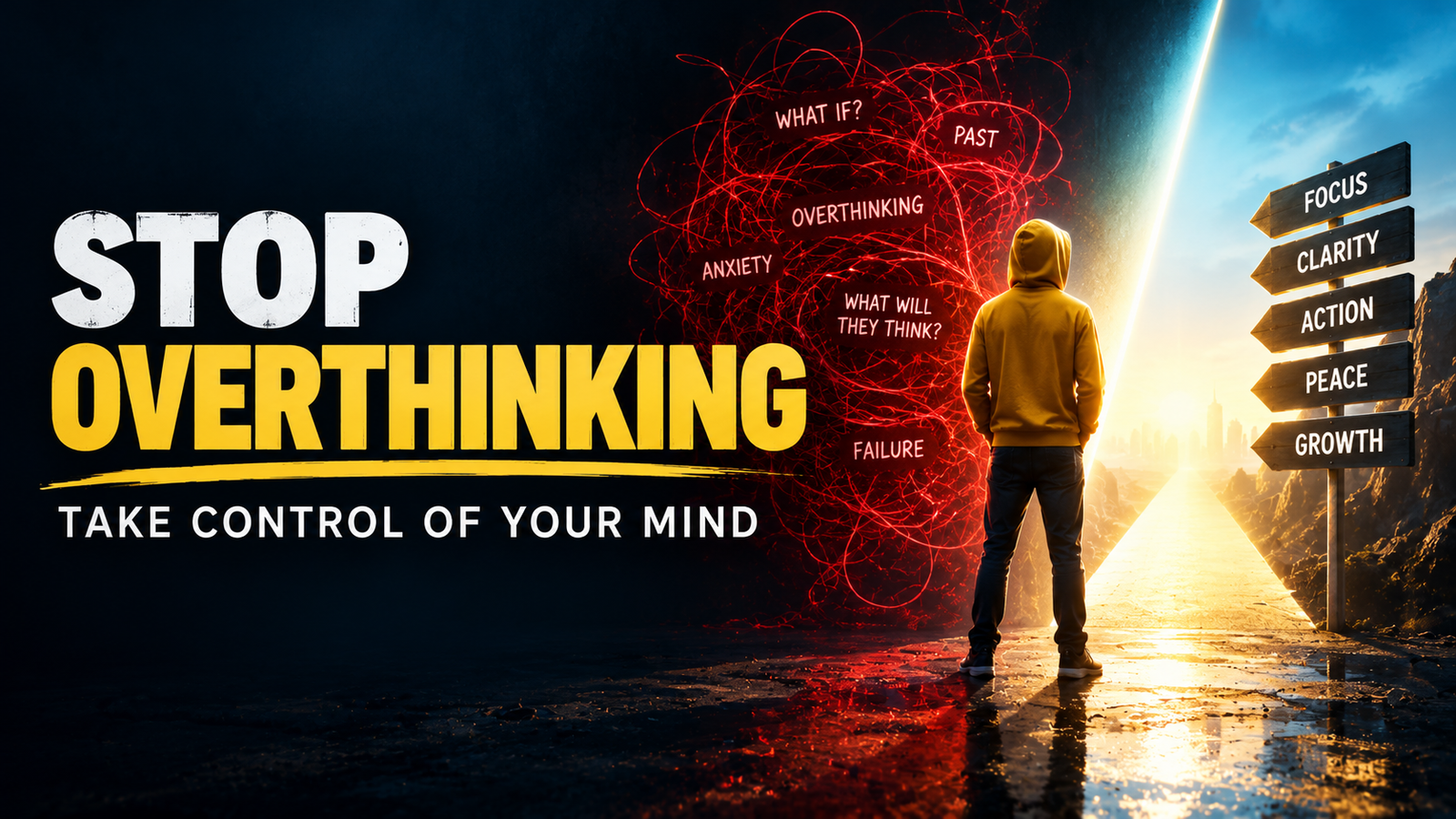
Your mind is constantly producing thoughts. Some help you solve problems, make better decisions, and move forward. Others pull you into yesterday’s regrets, tomorrow’s worries, and endless imaginary conversations.
The biggest problem isn’t that you have too many thoughts. It’s that you give too many of them your attention.
Imagine how much of your mental energy disappears every day thinking about things you cannot change, situations you cannot control, and problems that may never happen.
What if you could learn to filter those thoughts, protect your attention, and focus only on what moves your life forward?
The secret is not to stop thinking. It is to start thinking with purpose.
Inspired by practical thinking principles and the Stoic philosophy of controlling your responses, here are seven powerful rules to help you develop a clearer, calmer, and more disciplined mind.
1. Understand That Not Every Thought Deserves Your Attention
Think about the last hour of your day.
Did you replay an awkward conversation? Worry about an unanswered message? Imagine something going wrong at work? Compare your progress with someone else’s success?
These thoughts can feel important because they create strong emotions. But emotional intensity does not automatically make a thought useful.
A thought is worth your attention when it helps you understand something, solve a problem, make a decision, or take meaningful action.
The rest may simply be mental noise.
Try asking yourself:
“Is this thought helping me solve something, or am I just repeating it?”
You may not control every thought that enters your mind, but you can practice choosing which thoughts deserve your attention.
2. Use the Filter of Utility
One of the simplest ways to improve your thinking is to separate useful thoughts from unproductive mental clutter.
A useful thought creates value. It helps you prepare for a meeting, improve your health, manage your finances, or solve a real challenge.
An unproductive thought keeps repeating without producing a practical next step.
For example:
- “I made a mistake yesterday.” This can be useful if it helps you learn and improve.
- “I wish I could go back and change yesterday.” Repeating this thought cannot change the past.
- “I am worried about my future.” This becomes useful when you turn it into a plan.
- “What if everything goes wrong?” This creates anxiety without necessarily improving your preparation.
The goal is not to label every uncomfortable thought as useless. Some difficult thoughts reveal genuine problems that need attention.
The important distinction is whether your thinking leads somewhere.
3. Focus on What You Can Control
The ancient Stoic philosopher Epictetus taught an important lesson: some things are within our control, while others are not.
Your actions, choices, effort, preparation, and responses are areas where you have influence.
Other people’s opinions, unexpected events, traffic, market movements, and the past are not completely under your control.
Yet people often spend enormous energy trying to control precisely those things they cannot.
You cannot force someone to respect you. But you can choose how you respond.
You cannot guarantee business success. But you can improve your decisions and execution.
You cannot change yesterday. But you can make a better decision today.
Whenever you feel overwhelmed, divide a piece of paper into two columns:
Within My Control
- My actions
- My habits
- My words
- My preparation
- My next decision
Outside My Control
- Other people’s reactions
- Past events
- Unexpected changes
- The opinions of strangers
- Every possible future outcome
Put your energy into the first column.
That is where meaningful action begins.
4. Separate Facts From the Stories Your Mind Creates
This rule can change the way you handle everyday situations.
Imagine sending someone an important message. Hours pass, and there is no reply.
Your mind immediately starts creating explanations:
“They are ignoring me.”
“Maybe they don’t respect me.”
“Perhaps I did something wrong.”
But what is the actual fact?
Your message has not received a reply yet.
Everything else is an interpretation until you have more information.
Our emotions can influence how we interpret events. When we are anxious, tired, or frustrated, we may assume the worst without enough evidence.
Before reacting, ask yourself:
- What do I actually know?
- What am I assuming?
- Is there another reasonable explanation?
- Do I need more information before responding?
Separating facts from assumptions can prevent unnecessary arguments, impulsive decisions, and emotional exhaustion.
5. Give Important Decisions Time
Not every decision should be made immediately.
When emotions are intense, your judgment may become influenced by anger, fear, excitement, or disappointment.
You might send a message you later regret, quit a job without considering the consequences, or make a financial decision because you feel pressured.
For important decisions, try a deliberate pause.
The 48-hour deliberation rule can be a useful personal guideline: when a decision is significant and there is no genuine urgency, give yourself time to calm down, gather information, and examine the consequences.
Ask yourself:
- What are the possible outcomes?
- What evidence supports this decision?
- What could I regret later?
- Am I choosing based on facts or temporary emotions?
Of course, emergencies and time-sensitive responsibilities require timely action. The purpose of this rule is to avoid unnecessary impulsiveness, not to delay every decision.
6. Write Your Thoughts Down Instead of Carrying Everything in Your Head
When too many problems remain in your mind, even simple tasks can feel overwhelming.
You might be thinking about work deadlines, financial responsibilities, family matters, personal goals, and unfinished projects at the same time.
Instead of trying to solve everything mentally, take a notebook and write it down.
Create three simple sections:
Problems: What is bothering me?
Actions: What can I actually do about it?
Later: What needs attention, but not today?
For example:
Problem: I am worried about an upcoming presentation.
Action: Prepare the main points and practice for 20 minutes.
Later: Review the final slides tomorrow.
Writing turns vague worries into visible tasks. It helps you organize your priorities and decide what deserves attention first.
You do not have to solve every problem immediately. Sometimes, the first step toward clarity is simply getting everything out of your head and onto paper.
7. Protect Your Attention From the Modern World
Your attention is constantly being competed for.
Notifications, social media, breaking news, advertisements, and endless scrolling encourage you to switch between different sources of information.
Every interruption can make it harder to return to meaningful work.
If you consume information all day but rarely spend time thinking deeply, your mind may become reactive rather than focused.
Start protecting your attention with a few practical boundaries:
- Keep your phone away during important work.
- Turn off unnecessary notifications.
- Avoid checking social media immediately after waking up.
- Set specific times for news and online browsing.
- Spend at least 20–30 minutes each day on uninterrupted work or reflection.
- Choose what you consume instead of allowing algorithms to choose for you.
Remember: money can often be earned again, but time cannot be recovered.
Spend your attention as carefully as you spend your money.
Stop Asking “Why Is This Happening to Me?” Start Asking “What Can I Do Next?”
There is a powerful difference between these two questions.
“Why is this happening to me?” can keep you trapped in frustration, especially when you cannot find a satisfying answer.
“What is the next practical step?” moves your attention toward action.
Lost an opportunity? Identify what you can learn.
Made a mistake? Decide how to correct it.
Facing a difficult situation? Find the next manageable action.
You do not need to understand every reason behind every event before moving forward.
Sometimes, progress begins when you stop searching endlessly for explanations and start working with the situation in front of you.
A Simple Daily Routine for Mental Clarity
You don’t need a complicated system to start thinking better. Try this routine for the next seven days.
Morning — Choose your direction
Write down your three most important priorities. Identify one action that will make meaningful progress today.
During the day — Filter your thoughts
Whenever you catch yourself overthinking, ask: “Is this useful? Can I act on it? Is it within my control?”
Evening — Clear your mind
Spend five minutes writing down unfinished tasks, worries, and lessons from the day. Decide what needs attention tomorrow.
Before sleep — Reduce the noise
Put your phone aside and give your mind some time away from constant information.
Keep the routine simple enough to repeat.
Final Thoughts: Your Mind Needs Direction, Not More Noise
You cannot always control which thoughts appear in your mind. You cannot predict every situation or prevent every difficult emotion.
But you can become more intentional about where your attention goes.
Stop giving unlimited energy to imaginary problems. Separate facts from assumptions. Focus on what you can control. Write down your worries. Delay unnecessary emotional reactions. Protect your attention.
Clear thinking is not a gift reserved for a lucky few. It is a skill you can practice through small, deliberate choices.
The next time your mind becomes crowded, remember this:
You don’t have to believe every thought, answer every worry, or react to every situation.
Pause. Filter. Focus. Execute.
Your peace begins when you stop allowing every thought to control your life.
If you’re ready to take control of your attention and build a stronger mindset, subscribe to BeHappy Motivation. Comment “CLARITY” if you’re ready to stop overthinking and start taking action.
Frequently Asked Questions
How can I train my mind to think clearly?
Practice separating facts from assumptions, writing down your thoughts, limiting distractions, and focusing on one important task at a time. Consistent practice can improve your ability to organize your thinking.
How do I stop overthinking everything?
Notice when you are repeating the same thought without reaching a solution. Ask whether you can take a practical action. If not, try redirecting your attention to something meaningful or write the concern down for later.
What is the Stoic philosophy of control?
Stoicism teaches that we should distinguish between what is within our control and what is not. We can focus on our choices, actions, and responses rather than exhausting ourselves trying to control external events.
How can writing help with mental clarity?
Writing helps turn vague concerns into specific statements and manageable tasks. It can make priorities easier to identify and reduce the mental effort involved in remembering everything.
Why is protecting attention important?
Attention determines what receives your time and mental energy. Reducing unnecessary interruptions can help you concentrate, complete meaningful work, and make more deliberate decisions.