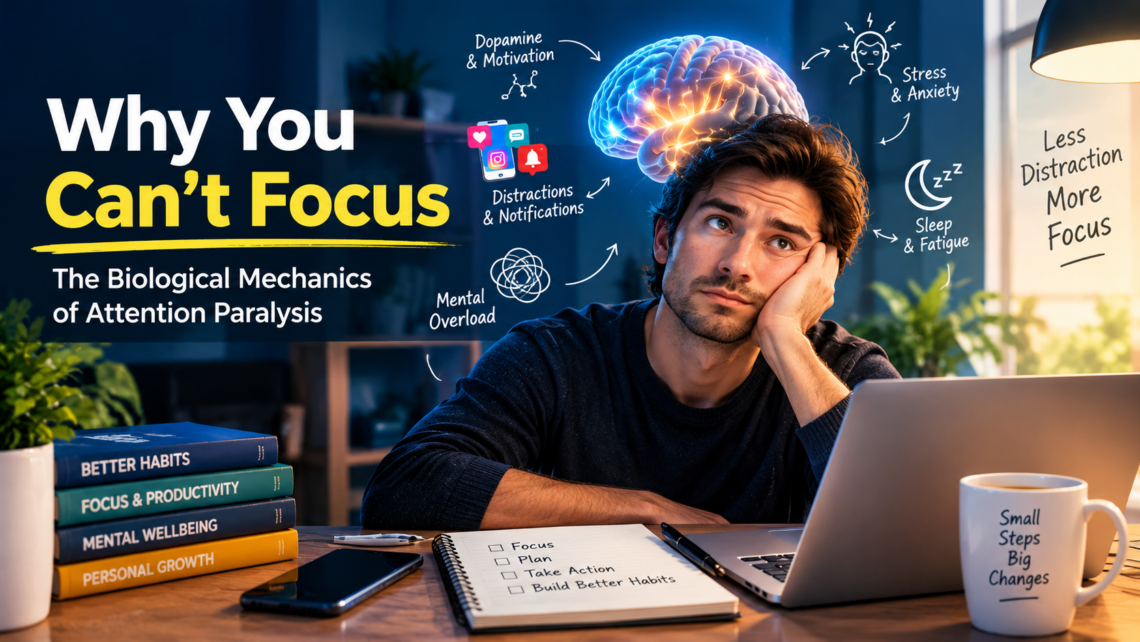
Introduction: Why Is Focusing So Difficult Today?
You sit down to finish an important task. Your laptop is open, your coffee is ready, and you know exactly what needs to be done. Yet, a few minutes later, you’re checking your phone, opening another tab, or staring at the screen without making progress.
Sound familiar?
The frustrating part is that you genuinely want to concentrate. You might even feel anxious about the work you’re avoiding. Still, getting started feels strangely difficult.
This experience is sometimes described as attention paralysis: a state in which focusing, choosing a task, or taking action feels harder than it should. It isn’t a formal medical diagnosis, but it can describe a real and frustrating experience.
Your brain is constantly balancing competing demands, emotional signals, memories, and incoming information. When those demands become overwhelming, concentration can suffer.
Understanding why this happens is the first step toward learning how to regain your focus.
1. Your Brain Wasn’t Designed for Endless Notifications
Every notification, message, headline, and short video competes for a limited amount of attention. Modern digital environments make switching between these distractions almost effortless.
Your brain uses attention to prioritize information that appears important, interesting, or potentially rewarding. An unexpected notification can interrupt your current train of thought because it introduces something new that might require a response.
The problem is that returning to a demanding task often requires mental effort. You must remember where you stopped, reconstruct your train of thought, and decide what to do next.
Repeat this process throughout the day, and even relatively simple work can feel exhausting.
The solution isn’t necessarily to abandon technology. It’s to create boundaries around it. Silence unnecessary notifications, close irrelevant tabs, and keep your phone out of reach during focused work.
Sometimes, improving concentration begins with removing the interruptions that repeatedly demand it.
2. Dopamine Is About More Than Motivation
Dopamine is often described online as the brain’s pleasure chemical. That explanation is incomplete.
Dopamine plays important roles in motivation, learning, reward prediction, and the processes that influence which actions seem worth pursuing.
Activities that provide immediate feedback or rewards, such as checking messages or watching entertaining videos, can be easier to choose than tasks whose benefits arrive much later.
Consider the difference between scrolling through social media and working on a difficult project. Scrolling offers frequent changes and immediate stimulation. The project may require sustained effort before you see meaningful results.
Your brain can be drawn toward the easier option, especially when you’re tired, stressed, or uncertain about how to begin.
This doesn’t mean your dopamine system is permanently damaged or that you need a so-called dopamine detox. A more practical approach is to make important tasks easier to start and reduce easy distractions during work.
For example, commit to writing one paragraph rather than finishing an entire article. Small, visible progress can make a demanding task feel more manageable.
3. Mental Overload Can Create Attention Paralysis
Sometimes, the problem isn’t a lack of motivation. It’s having too many things to think about at once.
Imagine you’re worried about money, responding to work messages, planning your future, and trying to complete an important assignment. Each concern competes for mental space.
Working memory—the system that temporarily holds and manipulates information—has limited capacity. When too many demands compete for that capacity, planning and decision-making can become more difficult.
This can create a frustrating cycle. You have several tasks to complete, so you struggle to choose one. Because you don’t start, the tasks remain unfinished. The growing backlog creates even more stress.
To interrupt this cycle, take your thoughts out of your head and put them on paper.
Write down everything that needs attention. Choose one task that matters most, then identify the smallest practical action you can take immediately.
You don’t need to solve every problem before beginning. You only need a clear next step.
4. Stress Can Make Concentration Harder
When you’re under pressure, your brain and body respond to demands by activating stress-related systems. In the short term, this response can help you react to challenges. When stress becomes persistent, however, it can interfere with sleep, memory, attention, and decision-making.
This explains why you might struggle to concentrate even when something is extremely important to you.
You may be thinking about the consequences of failure instead of the work itself. You might repeatedly imagine everything that could go wrong, leaving less attention available for the task in front of you.
Try reducing the pressure associated with getting started.
Instead of telling yourself, “I have to finish this perfectly,” try, “I’ll work on the first step for ten minutes.”
Take a few slow breaths, relax your shoulders, and focus on one action at a time. A brief walk or a short break can also help when you feel mentally overwhelmed.
The goal isn’t to eliminate every stressful thought. It’s to prevent those thoughts from controlling your next action.
5. Sleep and Mental Fatigue Matter More Than You Think
Sometimes, your concentration problems have a surprisingly simple explanation: you’re tired.
Sleep supports attention, learning, memory, and emotional regulation. When you consistently get insufficient sleep, tasks that normally feel manageable may require considerably more effort.
Mental fatigue can also build throughout a demanding day. If you’ve spent hours making decisions, switching between responsibilities, and managing interruptions, your ability to sustain attention may decline.
Start by observing your patterns.
Do you struggle to focus mainly in the afternoon? Does concentration become worse after a poor night’s sleep? Do you feel mentally exhausted after long periods of screen use?
These observations can help you identify practical changes.
Maintain a consistent sleep schedule, take regular breaks, stay physically active, and avoid scheduling every demanding task back-to-back.
If concentration difficulties persist despite adequate rest, or significantly interfere with everyday life, consider discussing them with a healthcare professional. Ongoing attention problems can have several causes, including anxiety, depression, ADHD, sleep disorders, and other health conditions.
6. How to Train Your Brain to Focus Again
You don’t need a complicated productivity system to begin improving your attention. Start with a simple routine.
Step 1: Choose one task. Decide what deserves your attention instead of trying to do everything simultaneously.
Step 2: Remove distractions. Silence notifications and create a workspace that supports concentration.
Step 3: Start small. Work for ten or fifteen minutes if a longer session feels overwhelming.
Step 4: Take intentional breaks. Stand up, stretch, walk, or rest your eyes before returning to the task.
Step 5: Track what works. Notice when you concentrate best and which habits repeatedly interrupt your progress.
With practice, these changes can help you develop a more reliable approach to focused work. Progress may be gradual, and different strategies work for different people.
Conclusion: Your Brain Isn’t Always the Problem
If you can’t focus, it doesn’t automatically mean you’re lazy, undisciplined, or incapable of achieving your goals.
Your attention is influenced by biology, sleep, stress, your surroundings, and the demands you place on yourself. When these factors work against you, concentrating can become genuinely difficult.
Instead of blaming yourself, start by understanding what’s getting in the way.
Put your phone aside, write down your priorities, choose one manageable task, and give yourself permission to begin imperfectly.
You don’t have to control every thought that enters your mind. You only need to practice directing your attention toward what matters, one decision at a time.
Focus isn’t about forcing your brain to work harder every minute. It’s about creating the conditions that make concentration easier.
- How to Stop Procrastinating and Take Action
- How to Improve Focus and Concentration Naturally
- The Science of Dopamine and Motivation
- How Sleep Affects Productivity
- Practical Stress Management Techniques